
Introduction: My journey to recovering from Post-Finasteride Syndrome
When I developed Post-Finasteride Syndrome (PFS) after taking finasteride in 2015–2016, I had no idea what to do.
I experienced a range of debilitating symptoms, including fatigue, brain fog, insomnia, emotional blunting, sexual dysfunction and gut problems. My health deteriorated to the point where I struggled to function normally for years.
Like many men experiencing PFS, I spent a considerable amount of time searching for answers.
I wanted to understand what had happened to my body, why I was experiencing so many different symptoms and, most importantly, what I could do to start feeling better.
Eventually, I began researching others who had recovered naturally using nutrition, detox, gut health, exercise, sleep and other aspects of physiology that I believed might be relevant to my recovery.
Over time, I developed a more structured approach to optimising my health. I gradually incorporated not only detox methods, but changes to my diet, supplementation, training, sleep, stress management and gut health.
My recovery wasn't immediate, and it certainly wasn't linear. It took years of research, experimentation and consistency before I felt I was approaching my previous level of health.
Eventually, I reached a point where I felt approximately 90–95% recovered.
Recently, I revisited some blood test results and comprehensive stool analyses I had collected during my journey. There are many markers that I did not test throughout my recovery. Looking at the results side by side revealed changes in several of the markers I had been tracking.
What interested me most was that I had primarily judged my recovery by how I felt, rather than by what my test results showed. Yet, when I looked back at the data, I could see that several of my measurements had also changed considerably over the years.
In this article, I want to share my Post-Finasteride Syndrome recovery journey, including my blood test and gut health results, and explain the natural approach I followed.
My experience is just one personal account, but I hope sharing it helps other men researching PFS recovery understand the approach I took and why I believe comprehensive health optimisation deserves consideration.
These are my personal results, not proof that a particular protocol cures PFS. However, I hope sharing my experience provides useful information and encouragement to other men navigating this condition.
My natural approach to Post-Finasteride Syndrome
One of the biggest challenges I faced early in my journey was not knowing what to do.
I spent a long time researching different approaches, trying to understand the possible underlying mechanisms of PFS and looking for experiences from other men who had improved.
Reading about men who reported recovering through comprehensive lifestyle approaches gave me hope that there might be things I could do to support my own health.
It took me approximately two to three years to develop a more structured approach, and I introduced changes gradually.
My initial years were not spent consistently following the protocol I eventually developed. Much of that time was spent trying to understand my condition and working out which strategies might be worth exploring.
I believe much of my improvement occurred after I began taking a more comprehensive and systematic approach to my health.
The following were the main areas I focused on.
Nutrition and hormone-supportive foods
I began paying much closer attention to the quality of my diet.
My approach focused on whole foods, adequate protein, healthy fats and nutrient-dense foods that provide the building blocks required for normal physiological function.
This included foods such as eggs, red meat and oily fish, alongside a varied diet designed to provide essential vitamins, minerals and other nutrients.
I also focused on obtaining sufficient dietary fat and cholesterol, which the body uses in the production of steroid hormones.
I chose to minimise highly processed foods and industrially produced seed oils as part of my overall dietary approach. I also paid attention to foods I believed might be relevant to my hormonal health.
The objective was to build a sustainable way of eating that supported my overall health rather than relying on individual foods or supplements to solve everything.
Supplementation
I incorporated several supplements into my routine, including:
Vitamin D3 with K2.
Creatine.
Magnesium glycinate.
Glandular supplements.
Selected herbs intended to support hormonal health.
These formed part of my wider approach rather than being used as standalone treatments.
Importantly, the effects of supplements vary between individuals, and the evidence supporting their use for PFS specifically is limited. I cannot determine which, if any, contributed to my recovery.
Strength training and high-intensity exercise
Exercise became another important part of my routine.
My strength training focused on compound movements, relatively heavy loads, longer rest periods and shorter, purposeful sessions.
I wanted to build strength and muscle while allowing sufficient time for recovery.
I also incorporated high-intensity interval training (HIIT).
Exercise can influence several aspects of health, including cardiovascular fitness, insulin sensitivity, body composition and mood. However, hormonal responses to exercise vary depending on the type, intensity and duration of training, as well as the individual.
My focus was on finding an approach that improved my fitness without leaving me feeling excessively fatigued or compromising my recovery.
Sleep and circadian rhythm
Sleep was another area I took seriously.
Rather than focusing only on what happened at bedtime, I began thinking about sleep as something influenced by my entire day.
My routine included paying attention to morning light exposure, maintaining a consistent sleep schedule, managing evening light exposure and developing better sleep hygiene.
I wanted to create the conditions for more consistent, restorative sleep.
This was particularly important given that insomnia had been one of my most disruptive symptoms.
Stress management
Living with PFS can be mentally exhausting.
The uncertainty, persistent symptoms and difficulty finding reliable answers can create considerable stress.
I incorporated techniques such as breathing exercises and meditation to help manage stress and improve my ability to cope with difficult periods.
These practices were not intended to suggest that PFS is simply a psychological condition. Rather, they were part of supporting my overall wellbeing while dealing with a challenging physical condition.
Gut health and the microbiome
Gut health became an increasingly important part of my approach to PFS recovery.
I had experienced significant gut problems during PFS, and I wanted to understand whether changes in my digestive health and gut microbiome might be relevant to my wider health.
I incorporated fermented foods and explored dietary strategies to support digestive function.
I also investigated approaches aimed at addressing potential microbial imbalances and supporting the intestinal environment. This included selected natural antimicrobials and nutrient-dense foods such as bone broth.
My interest in this area was one of the reasons I underwent comprehensive stool analysis.
Research has identified differences in gut microbiota composition in a small pilot study of men with PFS. This is an interesting finding that warrants further investigation, although it does not establish whether these differences cause PFS, result from it or are associated with other factors. Read the PFS gut microbiome study
I believe gut health deserves greater attention when exploring potential contributors to PFS and supporting overall health. However, the specific role of the gut microbiome in PFS recovery remains an open research question.
Reducing environmental exposures
I also became more conscious of the products and materials I encountered in everyday life.
I took steps to reduce unnecessary exposure to substances I was concerned about, including certain plastics, cookware materials and chemicals in household products.
The evidence linking individual everyday exposures to PFS is not established. My reasoning was to make practical changes I considered worthwhile while focusing primarily on the foundations of health.
Other lifestyle practices
Over time, I experimented with additional practices, including infrared sauna, intermittent fasting, Epsom salt baths, skin brushing and coffee enemas.
These were part of my personal exploration of natural approaches to health, rather than interventions whose effectiveness for PFS I had established.
It is important to distinguish between supporting the body's normal physiological processes and claiming to remove unspecified toxins. Evidence supporting detoxification programmes for eliminating toxins is limited, but I noticed many of the successful protocols for PFS included detox.
My overall focus was on taking a comprehensive approach to health rather than relying on any one of these practices.
Looking back, the most important change was not finding one perfect supplement or intervention.
It was developing a more comprehensive approach to my health and applying it consistently over time.
My Post-Finasteride Syndrome blood tests: Hormone results before and after recovery
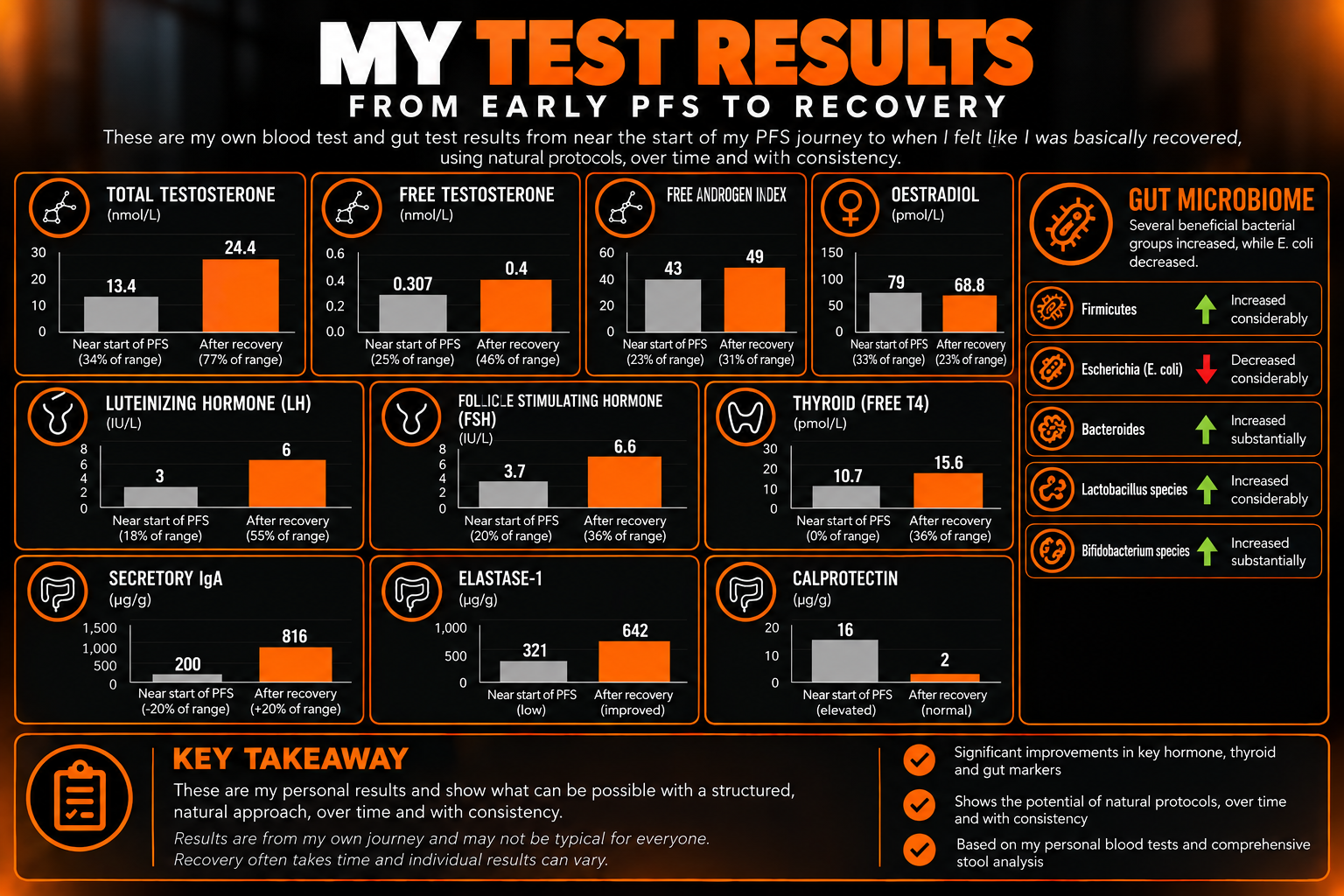
One of the most interesting parts of reviewing my results was comparing the hormone measurements from earlier in my PFS journey with those taken approximately five years later.
During that period, my approach to health changed considerably.
I was not consistently following a structured protocol throughout those five years. In fact, I spent much of the first two to three years trying to understand what was happening and working out what I could do to help myself.
I believe much of my improvement occurred after I began following a more comprehensive approach, although the timing of my test results means I cannot establish how much of the change was attributable to any particular intervention.
Here is what my recorded results showed.
Total testosterone
My total testosterone increased from 13.4 to 24.4 nmol/L.
This was one of the clearest changes in the results I recorded.
Testosterone is involved in several important physiological processes, including sexual function, muscle development, bone health and other aspects of male physiology.
However, testosterone levels alone cannot explain all the symptoms associated with PFS, and a higher result does not necessarily mean that every aspect of hormonal function has improved.
Free testosterone
My recorded free testosterone increased from 0.307 to 0.4 nmol/L. While not a big chance, it was now 46% through the reference range, whereas it was only 25% before.
Free testosterone refers to the fraction of testosterone that is not bound to proteins in the blood.
Its interpretation depends on the measurement method, laboratory reference range and wider clinical context. Nevertheless, the increase was another change I observed when comparing my results.
Free androgen index
My free androgen index increased from 43 to 49.
This index is calculated using testosterone and sex hormone-binding globulin (SHBG), and its interpretation has limitations. It is not a direct measurement of androgen receptor activity or the body's overall response to androgens.
That distinction matters in PFS, where symptoms cannot necessarily be understood by looking at circulating hormone levels alone.
Oestradiol
My oestradiol decreased from 79 to 68.8 pmol/L.
Oestradiol is an important hormone in men as well as women. It plays roles in bone health, sexual function and other physiological processes.
The goal is not simply to minimise oestradiol. Its significance depends on the individual's clinical context and the relationship between different hormones.
Luteinising hormone and follicle-stimulating hormone
I also tracked two hormones involved in the regulation of male reproductive function.
Luteinising hormone (LH) went from 3 IU/L to 6IU/L. This is a significant jump from 18% to 55% through the reference range.
Follicle-stimulating hormone (FSH) went from 3.7 IU/L to 6.6 IU/L. This is a jump from 20% to 47% through the reference range.
LH signals the testes to produce testosterone, while FSH plays an important role in supporting sperm production.
These hormones are best interpreted alongside other reproductive hormones, symptoms and relevant clinical information.
Taken together, my results show that several of the hormone measurements I tracked were different by the time I felt substantially recovered.
What I cannot conclude is that these changes caused my recovery or that achieving similar numbers would produce the same outcome in another man with PFS.
Nevertheless, they form an interesting part of my personal recovery story.
My thyroid results
I also tracked free thyroxine, commonly referred to as free T4.
My free T4 increased from 10.7 to 15.6 pmol/L.
Thyroid hormones play important roles in energy metabolism and the regulation of numerous physiological processes.
Given that fatigue and other symptoms affecting my day-to-day functioning were part of my experience with PFS, I found this change interesting when reviewing my results.
My results do not establish that thyroid function was responsible for my PFS symptoms or that the changes in free T4 contributed directly to my recovery.
They are another example of how some of the measurements I tracked differed between the two periods.
Post-Finasteride Syndrome and gut health: What my stool tests revealed
This is arguably the area I find most interesting.
Gut health was an important part of my personal experience because I had digestive problems during PFS.
It was also an area where I wanted more information beyond how I felt, which is why I underwent comprehensive stool analysis.
I believe the gut microbiome deserves greater attention when exploring PFS and potential approaches to supporting recovery.
That does not mean gut dysfunction is the established cause of PFS. Rather, I think the relationship between the gut, immune function, metabolism and the wider body is worth investigating.
My recorded stool analysis results included the following.
Secretory IgA
Secretory immunoglobulin A, or sIgA, is an antibody involved in immune defence at mucosal surfaces, including the intestinal lining.
My recorded result increased from 200 to 816.
The initial result was recorded as below the laboratory's reference range, while the later result was above it.
Elastase-1
Faecal elastase is commonly used to help assess pancreatic digestive enzyme production.
My recorded result increased from 321 to 642.
This was another notable difference between my two stool analyses.
Calprotectin
Faecal calprotectin is a marker used to help assess intestinal inflammation.
My recorded result decreased from 16 to 2.
This was a decrease in a marker commonly used in the assessment of intestinal inflammation.
Changes in my gut microbiome
I also tracked changes in several bacterial groups over three time points during my PFS journey. Looking back at the results, I noticed some substantial differences in the composition of my gut microbiome.
The main changes I recorded included:
Firmicutes: Increased considerably.
Escherichia (E. coli): Decreased considerably.
Bacteroides: Increased substantially.
Lactobacillus species: Increased considerably.
Bifidobacterium species: Increased substantially.
The recorded results showed positive changes in these bacterial measurements over time.
What I find particularly interesting is that these changes occurred over the period in which I was working to improve my overall health and eventually felt substantially recovered.
I cannot be sure whether the changes in my microbiome contributed to my recovery, but they reinforce my interest in the relationship between gut health and PFS. Combined with emerging research into the gut microbiome in men with PFS, this is an area I believe deserves further investigation.
Why I believe gut health deserves more attention in PFS
The gut is involved in digestion, nutrient absorption, immune function and communication with other systems in the body.
The gut microbiome is also an active area of research into interactions between the digestive system and wider physiological processes.
Importantly, there is already some preliminary PFS-specific microbiome research.
A small pilot study published in 2021 reported differences in gut microbiota composition between a group of men with PFS and healthy controls. The researchers suggested that these differences warranted further investigation as a possible avenue for understanding the condition. The study did not establish whether the differences caused PFS or whether changing the microbiome could improve it. Read the research on the gut microbiome and PFS
I find this area of research interesting because it aligns with something I experienced personally: gut problems were part of my illness, and gut health became an important part of my approach to optimising my overall health.
This is one of the reasons I include gut health strategies in The PFS Recovery Program.
My approach includes dietary strategies, fermented foods where appropriate, and attention to digestive health.
I believe this area deserves consideration alongside detox, nutrition, exercise, sleep, stress management and other aspects of health optimisation.
However, I want to be clear that the role of the gut microbiome in PFS remains uncertain. My experience and test results cannot establish that improving gut health treats PFS, and further research is needed to understand whether particular gut-related interventions could benefit men with the condition.
How my symptoms changed during recovery
Although my test results are interesting, they were never my primary way of measuring recovery.
I judged my progress mainly by how I felt and how well I could function in everyday life.
My symptoms did not all improve at the same rate.
Some of the earliest improvements I noticed were in my insomnia, gut problems and depression.
Other symptoms, including fatigue, brain fog, sexual symptoms, tinnitus and head pressure, improved much more gradually.
There were also periods when I felt better and periods when symptoms returned or became more difficult to manage.
This up-and-down pattern was one of the most challenging aspects of the process.
It could be difficult to know whether I was genuinely progressing, particularly when a difficult period followed a period of improvement.
Looking back, however, my overall trajectory was positive.
Over time, I felt increasingly better, and eventually I reached a point where I considered myself approximately 90–95% recovered.
The test results I have shared were collected approximately five years apart.
During those years, my approach to health changed considerably. I spent the first two to three years without a consistent, comprehensive protocol, and I believe much of my progress occurred after I developed and followed a more structured approach.
I cannot establish precisely when individual test markers changed or how closely those changes corresponded to improvements in particular symptoms.
Nevertheless, it was interesting to see that the results I had recorded also differed substantially when I compared the earlier and later tests.
For me, the most meaningful evidence of recovery was how I felt. The test results provided additional information that helped me reflect on the changes that had occurred.
What do my results tell us about natural PFS recovery?
I think there are several important lessons from my experience.
A comprehensive approach may be worth exploring
My approach did not revolve around one supplement, one food or one lifestyle intervention.
It involved multiple areas of health, including detox, nutrition, exercise, sleep, stress management and gut health.
I believe it is worth considering how these areas work together when supporting overall health.
However, my experience cannot tell us which interventions mattered most.
Consistency and time mattered to my journey
It took me years to understand my condition better and develop an approach I felt comfortable following.
I did not have all the answers at the beginning.
My approach developed gradually, and I learned through research, personal experience and experimentation.
For me, this was a long-term process rather than a quick fix.
Test results can provide useful information, but they do not tell the whole story
My blood tests and stool analyses provided information about selected physiological markers.
They did not measure every aspect of my health, and they could not tell me precisely why my symptoms improved.
Some aspects of PFS may not be reflected in routine blood tests, and there is currently no established set of laboratory markers that can definitively measure PFS recovery.
A person's symptoms, daily functioning and overall clinical picture remain important.
My experience is not a guarantee of recovery for someone else
I want to be clear about this because I know how difficult PFS can be.
I cannot promise that another man will also recover from PFS by following the same approach. But improvements in health are pretty much guaranteed.
My results represent one person's experience over approximately five years.
They are interesting observations, but they are not a controlled study or proof of treatment effectiveness.
I hope that sharing my experience provides encouragement while helping other men understand why I believe comprehensive health optimisation is worth considering.
Why I created The PFS Recovery Program
One of the reasons I decided to create OC NutriHealth was that I remembered how difficult it was to navigate PFS when I first developed it.
I spent years trying to understand what was happening and working out which approaches might be worth exploring.
I know how overwhelming it can feel when you are dealing with persistent symptoms and searching for answers.
Eventually, I developed a structured approach based on the principles I had explored during my own recovery.
I created The PFS Recovery Program to make this approach more accessible to other men.
The program focuses on supporting overall health through areas such as:
Detoxification support.
Nutrition and dietary habits.
Supplementation considerations.
Exercise and physical recovery.
Sleep and daily routines.
Stress management.
Gut health and the microbiome.
Lifestyle factors and environmental exposures.
Ongoing support, progress tracking and accountability.
The aim is to provide a structured program rather than leaving you to piece everything together through years of independent research.
The program is self-paced and includes written guidance, practical action steps and a private member community where you can ask questions and receive support.
The program does not promise to cure PFS, and my personal results should not be interpreted as evidence that every member will experience the same changes.
Instead, it offers a structured way to work on the foundations of your health while navigating a difficult condition.
If you want a clearer, more structured approach to optimising your health while dealing with PFS, The PFS Recovery Program can help you put these principles into practice.
If you would prefer to discuss your situation before joining, you can also…
Final thoughts
Looking back at my recovery journey, I find it interesting to see how my blood test and stool analysis results changed over approximately five years.
My total testosterone increased from 13.4 to 24.4 nmol/L. My free testosterone, free androgen index, LH, FSH and free T4 also increased, while my oestradiol decreased.
My stool analysis showed changes in secretory IgA, elastase-1, calprotectin and several bacterial measurements.
These changes occurred during a period in which my symptoms also improved and I eventually felt approximately 90–95% recovered.
I cannot establish that the changes in these markers caused my recovery, or that my natural protocols produced the changes. Nor can I determine which aspects of my approach were most important.
However, I believe the results are worth sharing because they form part of my personal experience and illustrate why I became interested in taking a comprehensive approach to health optimisation.
For me, recovery involved learning, experimentation, consistency and time.
I hope that sharing my experience gives other men with Post-Finasteride Syndrome another perspective to consider as they navigate their own journeys.
If there is one message I would leave you with, it is this: you do not need to have all the answers at the beginning. Learning about your health, taking a structured approach and making sustainable changes can be worthwhile steps, even when the outcome is uncertain.
If you are struggling with PFS and want support in taking a more structured approach to your health, you can learn more about The PFS Recovery Program below.
Disclaimer: This article is provided for educational and informational purposes only. It reflects my personal experience and interpretation of my own test results, which may not be representative of other individuals. The information is compiled in good faith but may contain errors or interpretations that are incomplete or incorrect. No liability is accepted for any loss or harm arising from reliance on this content. The article is not a substitute for professional medical advice, diagnosis or treatment. Do not change prescribed medication or undertake potentially risky interventions based solely on this article. Consult a qualified healthcare professional regarding your individual circumstances.
